
The CEO’s Guide to Building Trust and Commanding Premium Prices in New Zealand
In the B2B market, differentiation is a constant challenge. Your competitors offer similar products and services, often competing on price alone—a race to the bottom that erodes margins and brand value. There is, however, a powerful strategy to exit this cycle. It involves shifting from being just another vendor to becoming the definitive authority in your field. This is achieved through evidence-backed thought leadership, a method that not only builds deep customer trust but also gives you the justification to command premium prices.
Research confirms this is not just theory. A significant 60% of business decision-makers state they are willing to pay more for a brand that demonstrates strong thought leadership. This isn’t about clever marketing slogans or a slick website. It’s about providing genuine, data-driven insights that help your clients solve their most pressing problems. For NZ CEOs, mastering this approach is the key to creating a sustainable competitive advantage, attracting high-value clients, and fundamentally changing the conversation from “how much does it cost?” to “what is the value you provide?”.
What Exactly Is Evidence-Backed Thought Leadership?
Evidence-backed thought leadership is the strategic creation and distribution of content based on original research, proprietary data or unique analysis. It goes far beyond standard content marketing, which often explains existing concepts. Instead, it generates new insights and presents a distinct point of view on industry trends, challenges, and opportunities.
Think of the difference between an article that lists “5 Tips for Better Cybersecurity” and a comprehensive report your company publishes on “The State of Cybersecurity Threats for New Zealand SMEs in 2026,” based on a survey of 500 local businesses. The first is helpful; the second is authoritative.
The core components include:
- Original Research: Conducting surveys, interviews, or market studies to generate new data.
- Proprietary Data Analysis: Analysing your own internal data to uncover trends and benchmarks that no one else has.
- Expert Analysis: Applying your unique experience and expertise to interpret existing data in a new and insightful way.
This approach positions your brand not as a seller of products, but as a valuable partner with indispensable knowledge. It is the most direct path to establishing genuine authority.
Why NZ CEOs Must Prioritise This Strategy
For a leader focused on the bottom line, any strategic initiative must deliver tangible returns. Evidence-backed thought leadership directly impacts key business metrics, moving from a “nice-to-have” marketing activity to a core driver of growth and profitability.
Command Premium Pricing in a Competitive Market
When your company is the source of definitive industry data, you change the dynamics of the sales process. You are no longer just responding to tenders; you are shaping the requirements. The statistic, from the Edelman–LinkedIn B2B Thought Leadership Impact Report, that 60% of decision-makers will pay more for brands with strong thought leadership is a direct reflection of this. When your insights help a potential client understand their problem better than anyone else, the value of your solution becomes self-evident. Price becomes a secondary consideration to the value and security your expertise provides. This allows you to protect your margins and invest back into innovation and talent.
Build Unshakeable Customer Trust and Credibility
Trust is the foundation of any long-term business relationship. Publishing data-driven, objective content demonstrates a commitment to your industry and your clients’ success that goes beyond a simple transaction. It shows you have invested time and resources to understand the market’s challenges. This builds a level of credibility that advertising cannot buy. Clients see you as a reliable, authoritative source of information, which translates directly into trust for your products and services.
Shorten the Sales Cycle for High-Value Deals
The modern B2B buyer is highly informed. They conduct extensive research before ever speaking to a salesperson. Your thought leadership content meets them during this critical research phase. A well-researched white paper or an insightful webinar educates potential clients on their own problems and subtly introduces your unique approach as the solution. By the time they contact your sales team, they are already highly qualified and convinced of your expertise. This dramatically reduces the time and effort required to close complex, high-value deals.
Attract and Retain Top Kiwi Talent
A strong thought leadership programme has internal benefits as well. The best talent wants to work for companies that are recognised leaders and innovators. When your company is regularly featured in industry publications and business websites and your executives are sought-after speakers, it creates a powerful employer brand. It signals that your organisation is at the forefront of the industry, making it a more attractive and stimulating place to build a career. This helps you attract and retain the high-performing individuals needed to drive your business forward.
How to Develop an Evidence-Backed Thought Leadership Strategy
A successful programme requires a structured approach. It’s not about producing a single report but about building a sustainable system for generating and distributing unique insights.
Step 1: Identify Your Niche and Unique Point of View
You cannot be the leading expert on everything. Determine the specific area where your company has the most profound expertise and where you can offer a perspective no one else can. What are the biggest unanswered questions your clients have? What industry “truths” do you disagree with? Your unique point of view is the foundation of your entire strategy. For a New Zealand context, this could mean focusing on challenges specific to Kiwi businesses, such as scale, geographic isolation or specific regulatory environments. For businesses targeting global markets, it could be analysing data from one market and providing context to prospective clients in another.
Step 2: Commit to Original Research and Data Analysis
This is the “evidence-backed” component. Your commitment to generating new knowledge is what will set you apart.
- Conduct an Annual Survey: Poll your clients or a wider industry group on a key topic. This can become an anticipated annual report.
- Analyse Your Internal Data: You are likely sitting on a goldmine of data. Anonymise and aggregate customer data to reveal trends in usage, performance, or spending.
- Partner with an Academic Institution or Research Firm: Collaborate with experts to add an extra layer of credibility and rigour to your studies.

Step 3: Create High-Value Content Formats
Your groundbreaking research deserves a better home than a simple blog post. Package your insights into premium formats that reflect their value.
- Comprehensive Reports & White Papers: These are the cornerstone assets that present your full findings.
- Executive Summaries & Infographics: Create easily digestible versions for time-poor executives.
- Webinars & Live Events: Present your findings and host a Q&A session to engage your audience directly.
- Keynote Presentations: Equip your leadership team with compelling presentations to deliver at industry conferences.
Step 4: Distribute Your Insights Strategically
Creating the content is only half the battle. You need a multi-channel plan to ensure your insights reach the right people.
- Owned Channels: Feature the content prominently on your website, blog, and email newsletters.
- Social Media: Share key stats and takeaways on platforms like LinkedIn, where your target audience of NZ business leaders is active.
- Earned Media: Pitch your research findings to relevant industry journalists and publications. A unique NZ-specific data point is highly newsworthy.
- Partnerships: Co-author content or host joint webinars with complementary, non-competing organisations to expand your reach.
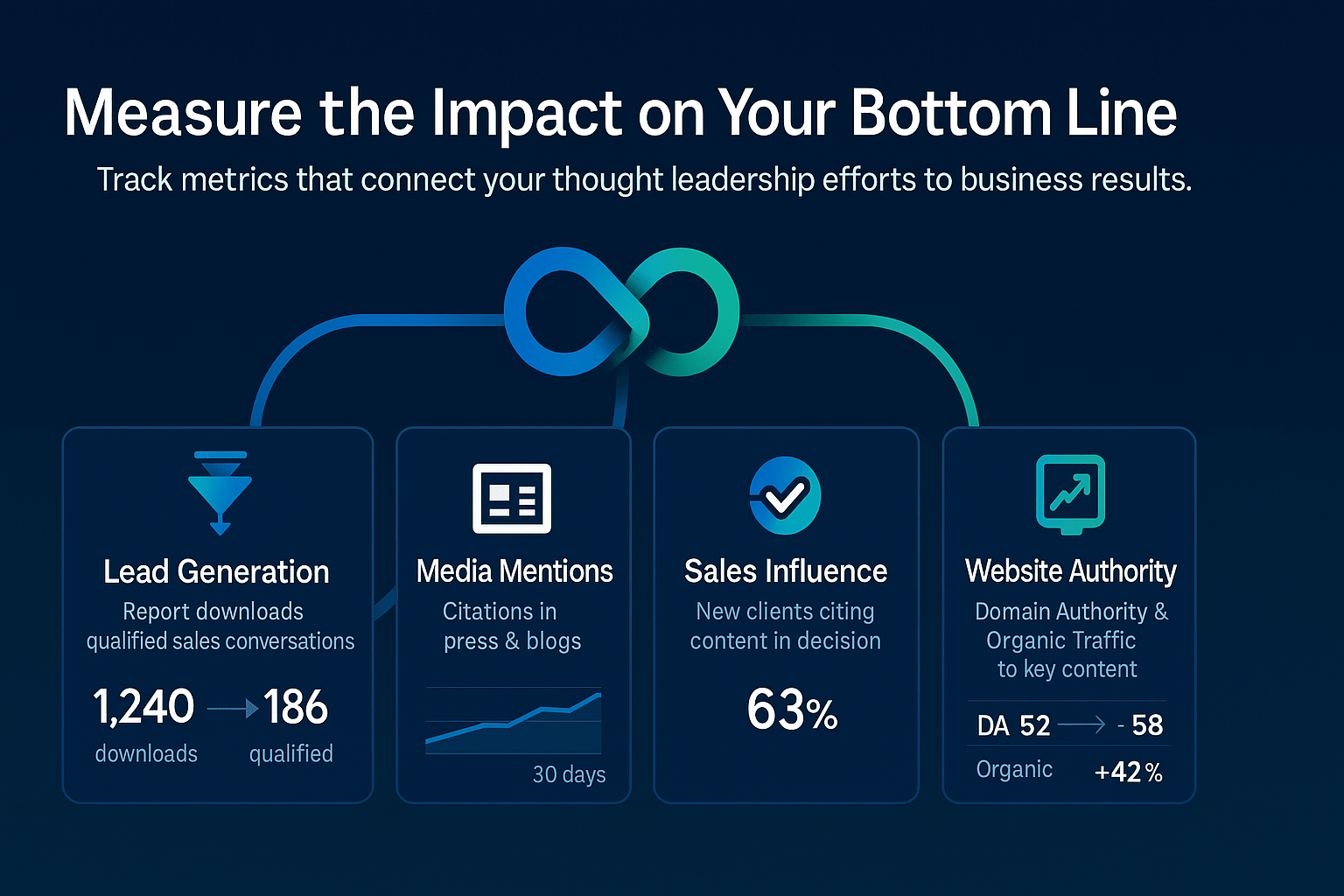
Step 5: Measure the Impact on Your Bottom Line
Track metrics that connect your thought leadership efforts to business results.
- Lead Generation: How many downloads of your report led to qualified sales conversations?
- Media Mentions: Track how often your company and research are cited in the media.
- Sales Influence: Ask new clients what role your content played in their decision-making process.
- Website Authority: Monitor increases in domain authority and organic traffic to your key content pieces.
Common Pitfalls to Avoid in Thought Leadership
Many attempts at thought leadership fail to deliver results because of a few common mistakes. Being aware of these can help you stay on track.
Mistaking Sales Pitches for Insights
The primary goal of your content must be to educate and inform, not to sell. If your “white paper” is just a product brochure in disguise, your audience will see right through it. Genuine thought leadership puts the audience’s needs first. The promotion of your business should be subtle and a natural consequence of your demonstrated expertise.
Lacking a Consistent Voice and Cadence
One great report followed by a year of silence will not build authority. Thought leadership is a long-term commitment. You need a consistent publishing schedule and a clear, recognisable voice across all your content. This builds anticipation and reinforces your position as a reliable source of information.
Ignoring the “Evidence-Backed” Component
Making bold claims without data to support them is simply opinion, not thought leadership. The power of this strategy lies in its foundation of credible evidence. Every major point you make should be supported by a data point, a case study, or a rigorous, logical argument. Without proof, your content is just more noise in a crowded market.
Final Thoughts
For New Zealand CEOs looking to build a resilient, high-margin business, the path forward is clear. Competing on price is a losing game. Competing on expertise is a winning strategy. By investing in evidence-backed thought leadership, you build a powerful moat around your business that competitors cannot easily cross. You establish the trust that turns prospects into clients, and clients into advocates. Most importantly, you earn the right to price your products and services based on the immense value you deliver, securing your company’s position as a true leader in the New Zealand market.
Frequently Asked Questions about Evidence-Backed Thought Leadership
Q: What is the difference between thought leadership and content marketing?
A: Content marketing often answers known questions and explains existing topics to attract an audience (e.g., “How to do X”). Evidence-backed thought leadership aims to answer questions people don’t even know they have yet, by generating new data and insights to establish the company as the foremost expert in its field.
Q: Can a small or medium-sized NZ business realistically compete in thought leadership?
A: Absolutely. Small businesses can be highly effective by focusing on a very specific niche. Instead of a broad industry survey, a smaller firm could produce a deep-dive report on a specific challenge faced by a subset of their clients. Hyper-focus and unique access to a niche audience can be a powerful advantage.
Q: How much does it cost to produce original research?
A: The cost can vary widely. A simple customer survey using online tools can be very low-cost. A larger, formal study in partnership with a research firm will require a more significant investment. The key is to start with what is feasible and ensure the quality of the research is sound, regardless of the budget.
Q: How long does it take to see results from a thought leadership programme?
A: This is a long-term strategy. While you may see some immediate benefits like media mentions or leads from a single report, the true rewards—brand authority, market leadership, and pricing power—are built over 12-24 months of consistent, high-quality output.

Be First to Comment